
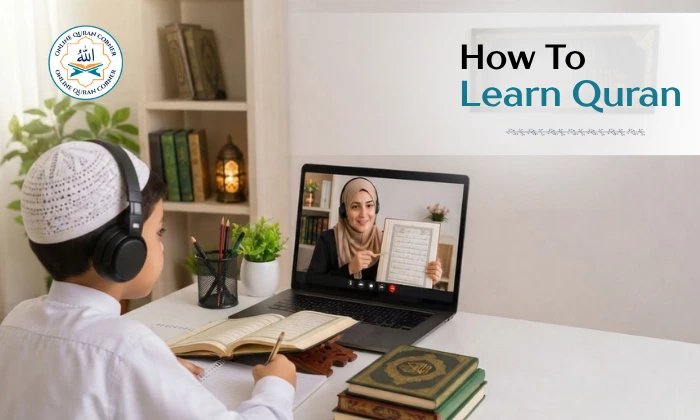
Many adults and parents want to know how to learn Quran without feeling overwhelmed by where to start. This guide breaks the process into clear steps, from choosing a teacher to building a daily habit that sticks.
Nothing here assumes prior experience. Whether you are a complete beginner or restarting after a long break, this applies to you. By the end, you will know exactly how to learn Quran online, step by step, at your own pace.
Start Your Quran Journey With Real Structure
A clear plan makes all the difference when starting something new. Online Quran Corner pairs beginners with qualified tutors from day one.
What Does Learning to Read the Quran Actually Involve?
Learning to read the Quran involves three connected skills: recognising Arabic letters, applying tajweed, and building fluency through repetition.
These skills build on each other. Letter recognition comes first, followed by correct pronunciation, then smoother, more natural recitation. Many beginners assume fluent Arabic is required first. In reality, structured lessons teach reading skills independently of general language study.
Understanding this upfront removes a lot of unnecessary pressure before you even begin your first lesson. Reading itself is a decoding skill, much like learning phonics in any other language for the first time.
Comprehension of meaning, through translation and tafseer, is a separate skill many students add later on. Our tafseer lessons build on this reading foundation once a student feels ready.
Parents searching for how to learn Quran on a child’s behalf find the same steps apply, just paced differently.
Why Learning the Quran in the UK Comes With Its Own Challenges
UK-based students often juggle school, work, and family commitments around lesson time, unlike in countries with dedicated Islamic schools.
Finding a qualified, native-fluent tutor locally can also be harder outside major cities with established Muslim communities.
Mosque-based classes, where available, often run at fixed times that clash with school or work schedules. Online lessons solve much of this, connecting UK families directly with experienced tutors regardless of location.
Time zones are rarely an issue either, since most academies offer scheduling that fits standard UK evening and weekend hours.
Students asking how to learn Quran in the UK specifically often find online lessons solve the access problem entirely.
Finding Your Starting Point Before You Begin
Before diving into lessons, it helps to honestly assess where you currently stand with Arabic letters and recitation.
This avoids wasted time repeating basics you already know, or skipping steps you genuinely still need.
What You Need to Start Learning Quran Online
A stable internet connection, a quiet space, and a device with video capability cover the practical basics.
Beyond equipment, you will need a copy of the Quran or Noorani Qaida, plus a notebook for tracking progress. Most academies provide digital materials directly, so you rarely need to purchase physical books before your first class.
Headphones can also help, especially in busy households where background noise easily interrupts concentration.
Keeping a simple log of letters or verses covered helps track progress without needing any special software. A basic printed calendar, marked with lesson days, works just as well as any dedicated tracking app.
Setting the Right Intention
Sincere intention, or niyyah, shapes how consistently a student shows up week after week.
Learning the Quran is an act of worship in itself, not just a language or literacy exercise. Keeping this intention in mind helps many students push through the slower, more frustrating early weeks.
Reconnecting with this purpose regularly, especially after a missed week, makes returning to lessons far easier.
Step-by-Step: How to Learn Quran Online
Knowing how to learn Quran online becomes far simpler once broken into five manageable, sequential steps.
Each step builds directly on the one before it, so skipping ahead usually creates gaps later on. Many students searching for how to learn Quran online expect a single trick, but a steady process matters more.
Step 1: Choose a Reputable Online Quran Academy
Look for verified tutor credentials, transparent pricing, and genuine student reviews before committing to any academy.
A clear complaints or feedback process also signals a genuinely accountable, well-run academy worth trusting. Online Quran Corner vets every tutor’s qualifications directly, rather than relying on self-reported credentials alone.
A short conversation with the academy before enrolling usually reveals whether their teaching style suits you.
Asking about tutor turnover is also worth doing, since frequent teacher changes disrupt a student’s progress.
Step 2: Start With Noorani Qaida if You’re a Beginner
The Noorani Qaida introduces Arabic letters, vowel sounds, and basic joining rules before any full verses.
Skipping this stage often causes pronunciation habits that become genuinely difficult to correct later on. Most students complete this foundation within a few months of consistent, twice-weekly lessons.
Some students revisit specific letters or rules briefly even after moving on to full verses, which is entirely normal. A patient tutor treats this as routine rather than a setback.
Step 3: Learn Proper Recitation With Tajweed
Tajweed teaches the precise pronunciation rules that give Quranic recitation its distinctive, correct sound.
This stage typically follows Noorani Qaida, once a student can confidently read individual letters and words. Proper recitation practice at this stage prevents mistakes from becoming permanent, hard-to-break habits.
Common tajweed rules include correct elongation, nasalisation, and pronunciation of letters unique to Arabic. Recording yourself occasionally and comparing it to a tutor’s recitation can highlight small errors you might otherwise miss.
Step 4: Practise Every Day
Even ten focused minutes daily outperforms one long, exhausting session crammed in once a week.
Consistency matters more than duration when building any new reading or recitation skill. Short, daily repetition helps the brain retain letter shapes and sounds far more effectively.
Pairing practice with a fixed time, such as after a prayer, turns it into an automatic habit quickly.
Step 5: Ask Questions During Your Lessons
Live, one-to-one lessons exist specifically so students can ask questions the moment confusion arises.
Silently nodding along without understanding usually means repeating the same mistake for weeks afterward. A good tutor welcomes questions and adjusts pace based on what a student actually needs.
Writing questions down between lessons, even small ones, ensures nothing gets forgotten by the next session.
How to Choose the Best Online Quran Academy
Choosing the right academy shapes your entire learning experience, from motivation to actual measurable progress. Not every platform offers the same quality of teaching, structure, or ongoing support.
| Factor | What to Look For |
|---|---|
| Tutor qualifications | Verified Ijazah, teaching experience, native or fluent Arabic |
| Class format | One-to-one lessons, not large group sessions |
| Scheduling | Flexible timings matching UK hours |
| Trial policy | A genuine free trial before committing |
| Safeguarding | Clear child protection and safety policies |
Qualified Teachers, One-to-One Classes, and Flexible Timings
One-to-one classes let a tutor adjust pace precisely to a single student’s pronunciation and comprehension. Flexible timings matter enormously for UK families balancing school runs, work shifts, and evening routines.
Instructors listed on our instructors page each hold verified teaching credentials before ever meeting a student.
Tutor experience with younger children specifically is worth checking separately, since not every qualified tutor teaches kids well.
Trial Classes and Student Reviews
A free trial class reveals more about teaching style than any written description ever could. Genuine student reviews, especially detailed ones, tend to reveal far more than a polished sales page.
Look specifically for mentions of tutor patience, communication style, and how well lessons suited a child’s personality.
Reading a handful of reviews before committing helps set realistic expectations from day one. Online Quran Corner publishes genuine student feedback rather than curated testimonials only.
Ready to Try a Free Trial Class?
See exactly how our tutors teach before committing to anything further. Online Quran Corner’s trial classes cost nothing and carry no obligation.
Can Anyone Learn Quran Online? A Guide by Age and Level
Age and prior experience shape how a lesson plan should look, though nobody is ever genuinely too old to begin.
Academies typically adjust teaching style significantly based on whether a student is a young child or an adult beginner.
How Children Learn Differently From Adults
Children generally respond well to shorter, gamified lessons with frequent repetition and visual aids.
Shorter attention spans mean twenty-minute sessions often work better than long, single-hour lessons for younger learners. Adults often prefer structured explanations and can grasp grammar-adjacent concepts, like tajweed rules, more quickly.
Adult students also tend to bring more self-discipline, though busier schedules can make daily practice harder to protect. Our guide on essential Islamic practices offers useful context for parents introducing these concepts at home.
Learning as a Complete Beginner vs Building on Tajweed or Hifz
Complete beginners start with letter recognition, while students with prior tajweed knowledge can move straight into memorization work.
Academies typically assess incoming students first, placing them at the appropriate stage rather than a fixed starting point.
This assessment step prevents wasted time and keeps motivation high from the very first lesson. Online Quran Corner runs this assessment during the free trial itself. Placement is rarely permanent either, since tutors regularly adjust pace as a student’s skills develop.
Learning Quran Without Speaking Arabic
Many students worry that not speaking Arabic will block them from ever learning to read the Quran properly.
In reality, Quran learning for non-Arabic speakers is extremely common and well supported by structured online programmes. Reading Arabic script does not require fluency in spoken, conversational Arabic at all.
The letters themselves are a fixed, learnable set, much like an alphabet in any other written language. Our learn Quran in English resources bridge this gap, explaining meaning and rules in plain English throughout.
Over time, many students naturally pick up common Quranic vocabulary, even without formal Arabic language study. This gradual exposure often builds enough familiarity to follow along with translations more confidently over time.
Many non-Arabic speakers eventually find the script easier than expected, since Arabic letters follow consistent, learnable patterns.
How to Memorize the Quran: Building a Realistic Schedule
Memorization, or Hifz, follows a different structure from simply learning to read fluently. Most successful students memorize small, consistent portions daily rather than attempting large chunks infrequently.
A typical Hifz schedule combines new memorization with regular revision of previously learned material.
Most tutors recommend starting Hifz only once basic tajweed feels comfortable and consistent.
| Weekly Focus | Typical Approach |
|---|---|
| New memorization | A few short verses, repeated aloud daily |
| Recent revision | Reviewing the past week's material |
| Long-term revision | Cycling back through older, previously memorized sections |
Skipping revision is the single most common reason memorized material fades within a few months. Reviewing older sections weekly, even briefly, keeps memorized verses accessible for years rather than months.
Many Hifz students pair memorization with a tajweed refresher, since accurate pronunciation supports stronger long-term recall.
The Best Apps and Self-Study Tools for Learning Quran
Apps work well as a supplement to live lessons, though they rarely replace a qualified tutor entirely. A Quran app with word-by-word translation helps students connect Arabic text directly to its meaning.
Audio recitation apps also help students hear correct pronunciation between scheduled lessons with their tutor. Faith-based learning apps have grown significantly in recent years, offering everything from flashcards to guided recitation practice.
Self-study tools work best when paired with regular feedback, since apps cannot correct subtle pronunciation errors alone. Tutors at Online Quran Corner often recommend specific apps to complement, not replace, live lessons.
How Long Does It Take to Learn to Read the Quran?
Most beginners take three to six months to comfortably complete Noorani Qaida with consistent, twice-weekly lessons. Building genuinely fluent, confident recitation typically takes another six to twelve months beyond that foundation.
Timelines vary considerably based on lesson frequency, daily practice, and how quickly a student was expected to progress. Students returning after a long break often need a short refresher period before regaining their previous pace.
Students hoping to learn Quran quickly should focus on consistency rather than rushing through foundational steps. Anyone wondering how to learn Quran in the shortest realistic time should prioritise daily practice over lesson quantity alone.
Common Mistakes and Challenges — and How to Fix Them
Skipping daily practice is the most common mistake, quietly undoing progress made during weekly lessons. Rushing through Noorani Qaida too fast often creates pronunciation habits that resurface later during tajweed lessons.
Inconsistent scheduling, where lessons happen irregularly, also slows progress far more than most students expect.
- Mistake: Practising only during lessons — Fix: Add ten minutes of daily reading at home
- Mistake: Ignoring tajweed early on — Fix: Ask your tutor to correct pronunciation from lesson one
- Mistake: Ambitious memorization goals — Fix: Start with a few verses and build gradually
- Mistake: Comparing progress to others — Fix: Track your own weekly improvement instead
Recognising these patterns early makes it far easier to correct course before habits become difficult to break.
A tutor who reviews progress regularly can usually spot these patterns before a student notices them personally.
Tips to Stay Consistent While Learning the Quran
Consistency, more than natural talent, determines how quickly a student actually progresses over time. These practical habits help many students stay motivated through the slower, less exciting early stages.
Small setbacks, like a missed week, matter far less than how quickly a student returns to routine afterward.
Set Realistic Goals and Build a Daily Routine
Small, specific goals, like ten minutes daily, are easier to sustain than vague, ambitious, open-ended targets. Attaching practice to an existing routine, like after Fajr, makes consistency far more automatic.
Writing goals down, rather than just thinking about them, noticeably improves how often students actually follow through.
Practise Outside Lessons and Listen to Experienced Reciters
Listening to skilled reciters between lessons trains the ear to recognise correct pronunciation naturally. This passive practice reinforces what a tutor teaches, without requiring extra active study time.
Choosing a small number of trusted reciters, rather than switching often, helps the ear adjust to one clear style. Consistency here mirrors consistency in daily practice generally.
Be Patient With Yourself
Progress rarely feels linear, and plateaus are a completely normal part of learning any new skill. Comparing your pace to someone else’s usually discourages more than it motivates genuine progress.
Celebrating small milestones, like finishing a page or a new tajweed rule, helps sustain motivation over the long run.
Frequently Asked Questions
Is Learning the Quran Online Effective?
Yes, when lessons are live, one-to-one, and taught by a qualified tutor with regular feedback.
What Is the Best Age to Learn the Quran?
There is no single best age. Children and adults both learn effectively with the right structured approach and support.
Do I Need to Know Arabic Before Learning the Quran?
No. Reading Quranic Arabic script is taught independently of spoken, conversational Arabic fluency entirely.
How Many Days a Week Should I Attend Quran Classes?
Two to three sessions weekly, paired with daily practice, works well for most beginner students overall.
What Should I Look for in an Online Quran Academy?
Verified tutor credentials, one-to-one classes, flexible timings, and clear safeguarding policies for all younger students.
Final Thoughts
Knowing how to learn Quran online comes down to consistency, the right tutor, and realistic expectations.
Progress is rarely instant, but small daily steps compound into genuine fluency over several months. Most students revisit these steps for how to learn Quran more than once as their skills grow.
Choosing wisely matters too. Our guide on choosing an online Quran teacher covers exactly what to check first. For parents specifically, our article on whether online Quran learning is safe addresses common safeguarding questions directly.
The UK government’s own guidance on safeguarding in remote education outlines what families should expect from any online learning provider.
Explore our full range of courses to see how recitation, tajweed, and Hifz lessons fit together.
Start Learning Quran Online With Online Quran Corner
Begin Your First Lesson With Confidence
Structured lessons, verified tutors, and flexible scheduling make starting simple. Online Quran Corner offers a genuine free trial class to every new student.