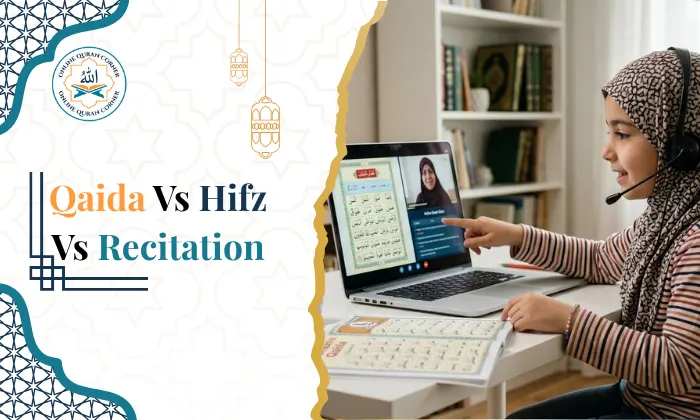
Parents researching Quran education online run into the same wall almost immediately: Qaida vs Hifz vs recitation, and no clear answer on which one their child actually needs first. Course pages throw around the three terms as if every family already knows the difference between them.
At Online Quran Corner, we get asked this question daily by UK parents booking their child’s first trial class. This guide breaks the Qaida vs Hifz vs recitation question down properly what each stage actually teaches, how the three connect, and which one is right for your child right now.
By the end, you’ll have a clear decision framework rather than just definitions, plus a side-by-side comparison table and a simple decision guide you can use to make the call with confidence.
Not sure where your child fits in?
Book a free trial class with Online Quran Corner and a tutor will assess your child’s level in the very first session.
What Is Noorani Qaida?
Noorani Qaida is the starting primer for Quran reading — a structured booklet that teaches the 28 Arabic letters, their individual sounds, and how they join together to form words. It’s the most common entry point into Quran education for children across the UK. Rather than jumping straight into Quran text, Qaida isolates each letter and sound in a simplified, step-by-step format. Students learn to recognise letter shapes, pronounce each sound correctly, and gradually combine letters into short words before opening the Quran itself. Because it strips reading down to its smallest components, Qaida is where correct pronunciation habits are formed for life. Mistakes at this stage can follow a student for years if uncorrected, which is why a dedicated, one-to-one Qaida course starts here rather than skipping to text a student isn’t ready for. Most Qaida books are organised into short, progressive lessons, each building on the last. A tutor working through Qaida one-to-one can spot and correct a mispronounced letter immediately, rather than letting it repeat across dozens of pages until it becomes a fixed habit. Islamic education has relied on this letter-by-letter method for generations, long before formal online classes existed. What’s changed is how consistently a tutor can now monitor progress lesson to lesson, rather than relying on students to self-correct between weekly sessions at a physical madrassah.How Qaida Builds the Foundation for Quran Reading
Qaida’s role in Quranic memorization is well documented among Islamic educators: a student who has genuinely mastered Qaida reads Arabic script fluently, without decoding letter by letter. That fluency later makes recitation, and eventually Hifz, achievable at a reasonable pace.
Skipping or rushing Qaida is a major reason children later struggle with recitation. A shaky foundation means each subsequent stage takes longer, because incorrect habits must be identified and unlearned before new, correct ones can be built.
This is also why Qaida shouldn’t be treated as a box-ticking exercise before “the real learning starts.” The habits formed here pronunciation, letter recognition speed, and confidence with unfamiliar words carry directly into recitation and memorization years later.
Who Should Start With Qaida First
Any child with no prior Arabic reading ability should start with Qaida, regardless of age. This includes children who speak Arabic conversationally but haven’t learned the script, since spoken fluency doesn’t automatically transfer to reading fluency.
Adult beginners follow the same rule, with no upper age limit to worry about. Our Noorani Qaida course is built for complete beginners of any age, with lessons paced around individual progress rather than a fixed calendar.
Parents sometimes assume an older child should “skip ahead” past Qaida because of age. In practice, age has little bearing on reading ability what matters is whether the letters and sounds are secure, which a tutor can confirm in a single assessment.
What Is Quran Recitation?
Quran recitation is the stage where a student reads directly from the Quran, applying correct pronunciation and rhythm to actual verses rather than isolated letters or short combinations. It sits between Qaida and Hifz in most structured learning paths.
Recitation isn’t simply “reading the Quran out loud.” It involves proper articulation points, known as makharij, correct vowel lengthening, and eventually tajweed rules that govern how the text flows from one word into the next. Done well, recitation reflects both accuracy and understanding of the text.
For most students, recitation is an ongoing skill rather than a course with a fixed end date. Even advanced Hifz-level students continue refining their recitation for years, since precision and fluency improve with regular practice.
Recitation quality also matters beyond the classroom it’s the skill used whenever a student reads Quran independently, leads prayer, or participates in family or community recitation. Building it properly early pays off throughout a student’s life, not just during a course.
Our dedicated Quran Recitation course follows this progression from first verses read aloud with support to independent, confident reading at a natural pace.
Improving recitation rarely comes from a single breakthrough. It’s a steady accumulation of small corrections a softened letter here, a lengthened vowel there repeated consistently until they become automatic rather than something the student must think about.
How Recitation Differs From Reading Qaida
Qaida teaches individual letters and short combinations in a simplified format designed specifically for learning. Recitation applies that same underlying skill to continuous Quranic text longer verses, connected sentences, and the natural pauses (waqf) that Qaida alone doesn’t cover.
In short: Qaida teaches a student to read; recitation teaches them to read the Quran specifically, at the standard it requires. One is preparation, the other is the applied, lifelong skill built on top of it.
Recitation and Tajweed: Why They Go Together
Tajweed is the rule set that governs correct Quranic pronunciation where to elongate a sound, where to soften a letter, where to pause naturally within a verse. Recitation without tajweed is technically reading; recitation with tajweed is reading the Quran as it was revealed to be read.
Our dedicated Quran Tajweed course runs alongside recitation training for most students, since the two are rarely taught in true isolation once a student progresses past the earliest basics of reading.
What Is Hifz (Quran Memorization)?
Hifz is the memorization of the Quran, verse by verse, until a student can recite the entire text or a significant portion from memory, without looking at the page. It’s the most demanding of the three stages and typically the longest by a considerable margin.
A student pursuing Hifz doesn’t start from zero. They need accurate Quran reading ability first, since Hifz relies on repeated correct recitation to lock verses into memory reading a verse incorrectly during memorization can mean memorizing that mistake permanently.
There’s also real spiritual weight attached to this stage: memorizing the Quran carries distinct significance in Islamic tradition, and a student who becomes a Hafiz holds that achievement for life, not just for the duration of a course.
Our Quran Hifz course structures memorization around daily, revisable targets rather than expecting students to absorb large blocks at once, which is exactly where most self-directed, unsupervised Hifz attempts tend to break down and stall.
Hifz Memorization Techniques and Daily Targets
Effective Hifz memorization techniques rely on repetition, structured revision, and understanding not just rote memorization with no system behind it. Most structured programmes set a small, achievable daily target, often a handful of verses, paired with regular revision of everything memorized so far.
Without consistent revision, memorized verses fade quickly Hifz is as much about retention systems as the initial act of memorizing. This is why one-to-one tutor guidance tends to outperform unsupervised memorization over time.
A tutor tracking daily targets and revision cycles can also catch small recitation errors before they become embedded in memory, which is harder to fix once a student has memorized a verse incorrectly and repeated it hundreds of times.
Revision structure typically follows a layered pattern: newly memorized verses are reviewed daily, recently completed sections weekly, and older sections on a longer rolling cycle. Without this layering, students often memorize new verses while older ones slowly slip away.
Is Hifz Necessary Before You Can Recite Well?
No — recitation and Hifz are related but genuinely separate skills. A student can become a confident, accurate reciter without pursuing full memorization, and many adult learners choose exactly that path deliberately.
Hifz is a deeper commitment built on solid recitation ability, not a mandatory next step for every Quran student. Whether to pursue it depends on the family’s goals and the student’s interest, not a fixed curriculum requirement.
Qaida vs Hifz vs Recitation: Key Differences at a Glance
Laid out side by side, the differences between the three stages become much clearer than any single definition can convey on its own. Use this table as a quick reference when deciding what to book first for your child.
| Course | Starting Point | Core Focus | Typical Duration | Best Suited For |
|---|---|---|---|---|
| Noorani Qaida | No prior Arabic reading ability | Letter recognition, sounds, joined reading | 3–6 months | Complete beginners, any age |
| Quran Recitation | Basic Qaida completed | Accurate verse reading, tajweed, fluency | Ongoing; roughly 6–12 months to fluency | Students ready to read the Quran directly |
| Hifz (Memorization) | Confident, accurate recitation ability | Memorizing verses, retention, structured revision | Several years, varies by pace | Students committing to full or partial memorization |
The pattern is consistent across almost every family we work with: Qaida vs Hifz vs recitation isn’t really a competition between three separate options it’s a sequence, with each stage depending directly on the one that came before it.
The Right Learning Order: Qaida, Then Recitation, Then Hifz
The most reliable learning order is Qaida first, recitation second, and Hifz third not an arbitrary preference. Each stage builds a skill the next depends on, so reversing the order can slow a student down rather than speed them up.
Students who attempt recitation before finishing Qaida often mispronounce letters without realizing it, because they never built the letter-level accuracy Qaida is designed to instill. Those errors can then carry into recitation and eventually memorization if left uncorrected.
There is some flexibility within this order a student doesn’t need to finish Qaida perfectly before starting basic recitation practice alongside it. However, the fundamentals need to be solid, which a tutor can assess directly rather than a parent guessing at home.
Families sometimes ask whether this order applies equally to adults. It does adult beginners benefit from the same sequence as children, even if they move through each stage faster due to stronger concentration and study habits.
Can a Child Start Hifz Without Finishing Qaida First?
It’s not recommended. A child who begins memorizing before their letter recognition and pronunciation are solid risks memorizing verses with built-in mistakes, which are far harder to correct later than they would have been to prevent at the Qaida stage.
Our tutors assess reading fluency directly before recommending a move into Hifz, rather than progressing every student on a fixed timeline regardless of individual readiness.
The Benefits of Combining Qaida, Recitation, and Hifz
Qaida, recitation, and Hifz work best as connected stages rather than separate choices. Each builds on the previous one, helping students read more accurately, recite correctly, and memorise with fewer errors while developing a deeper connection with the Quran.
- Stronger Qaida foundation: Mastering Qaida helps students read faster, more accurately, and with greater confidence.
- Better recitation: A solid Qaida foundation makes learning correct pronunciation and Tajweed easier and faster.
- More accurate Hifz: Strong recitation helps students memorise verses correctly from the beginning, reducing pronunciation errors.
- Deeper connection: Understanding what is being read or memorised can strengthen a student’s connection with the Quran.
A complete - learning journey: Qaida, recitation, and Hifz are not competing options; they are connected stages, and skipping foundational steps rarely saves the time families expect.
This is really the core answer to the Qaida vs Hifz vs recitation question once you look past the definitions: the three aren’t rival options competing for a family’s time, they’re stages of the same journey, and skipping ahead rarely saves the time parents hope it will.
Which Course Is Right for My Child? A Decision Guide
There isn’t one universal answer here the right starting point depends on your child’s current reading ability, their age, and what you actually want them to achieve over the next few years. The questions below narrow it down quickly.
Still unsure which course fits your child?
Message Online Quran Corner and a tutor will recommend a starting point based on a short, free assessment.
Best Age to Start Qaida, Recitation, and Hifz
Qaida can start from around age five, with lessons adjusted for shorter attention spans at that age and shorter session lengths to match. Recitation typically follows once basic letter fluency is in place, often somewhere between ages seven and ten, though this varies noticeably by student.
Hifz has no fixed starting age at all some children begin around age eight or nine once their recitation is confident, while many adults pursue it later in life with no upper limit whatsoever on when to start.
Choosing by Goal — Reading Fluency, Recitation Skill, or Full Memorization
If the goal is simply reading the Quran independently and correctly, Qaida followed by focused recitation training covers it fully full memorization isn’t required to read fluently, accurately, and confidently for life.
If the goal is memorizing part or all of the Quran, Hifz is the eventual target, but it should sit after, not instead of, solid Qaida and recitation foundations, for exactly the reasons covered earlier in this guide.
Some families choose a middle path deliberately: strong recitation and tajweed as the main goal, with partial Hifz a handful of shorter surahs layered on top, rather than committing to full memorization from day one.
Weighing Qaida vs Hifz vs recitation as a single decision often causes families to delay booking altogether, waiting until they’re “certain” which course is right. In practice, a short assessment session answers the question far faster than researching it alone ever will.
How Online Quran Corner Teaches Qaida, Recitation, and Hifz
Online Quran Corner runs all three stages as connected, one-to-one courses rather than a single generic “Quran class” that tries to cover everything at once. Students are assessed first, placed at the right starting point, and only progressed once a tutor confirms they’re genuinely ready.
Every course Qaida, recitation, tajweed, and Hifz is taught live over video by a dedicated tutor, with flexible, UK-friendly scheduling built around school and family routines rather than fixed class times that don’t fit real family life.
Families can also explore our full course catalogue beyond these three stages, including Hadith, Tafseer, and Ijazah study, for students who want to continue their Islamic education well past the recitation and memorization stages covered in this guide.
Progress is also tracked lesson to lesson rather than left to a parent’s impression of how things are going. A tutor working through Qaida, recitation, or Hifz one-to-one can flag exactly where a student is struggling, and adjust pace accordingly instead of pushing everyone through a fixed syllabus at the same speed.
One-to-One Lessons With Qualified, Vetted Tutors
Every tutor at Online Quran Corner is vetted before teaching, including identity verification, reference checks and a review of their original certificates, so families know exactly who is teaching before the first trial class.
Lessons stay one-to-one by default, so a tutor can correct small pronunciation errors immediately; The same errors that, left unaddressed, tend to compound across the Qaida, recitation, and Hifz stages covered throughout this guide. Meet our full teaching team on our instructors page before booking.
Frequently Asked Questions
What Is the Best Way to Learn Quran Effectively?
When comparing Qaida vs Hifz vs recitation, sequence matters more than choice: build letter accuracy first, then recitation with tajweed, then Hifz if memorization is your goal.
Should I Learn Qaida Before Reading the Quran?
Yes. Qaida builds the letter recognition and pronunciation accuracy that Quran reading depends on — skipping it usually means relearning fundamentals later, which takes longer overall.
How Long Does It Take to Finish Qaida, Recitation, and Hifz?
Qaida typically takes three to six months, recitation fluency develops over roughly six to twelve months, and Hifz can take several years, depending entirely on pace and consistency.
Can I Learn Recitation Without Completing Qaida First?
Technically yes, but it’s not advised. Recitation without solid Qaida foundations tends to carry forward pronunciation mistakes that become harder to correct the longer they go unaddressed.
Final Thoughts
Qaida vs Hifz vs recitation was never really an either-or decision to begin with it’s a progression, and understanding where your child currently stands is what actually determines the right starting point today.
Most families overthink the choice between courses when the real answer is simpler than it looks: start with an honest assessment of current ability, and let that not a course name alone decide what comes next for your child.
Our tutors handle that assessment directly in the first trial session, so you’re not left guessing between Qaida, recitation, and Hifz on your own, without guidance, at home.
Whichever stage your child starts at, the goal is the same one families have pursued for generations: accurate reading, confident recitation, and for those who choose it a lasting connection to the Quran built through memorization.
Start Your Child’s Quran Journey With Online Quran Corner
Give your child the right starting point, not a guess.
Book a free trial class with Online Quran Corner today — no card required. Or explore our full range of Online Quran classes to see every stage in detail.