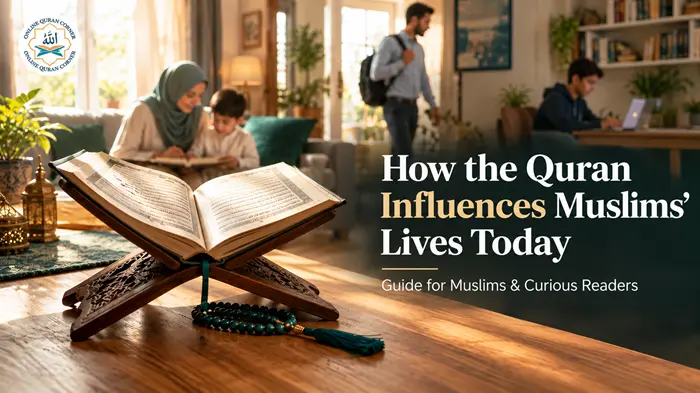
A Muslim wakes for Fajr, recites Al-Fatihah in prayer, and ends the day with a few verses. The Quran touches nearly every hour.
That is the short answer to how the Quran influences Muslims’ lives today. This guide gives the long answer with verses, survey data, and real examples.
It is written for students, curious readers, and Muslims who want to connect more deeply. Each section stands alone, so jump to what you need.
We use the Quran, authentic hadith, and Pew Research data. Views differ between communities, and we note where.
Our tutors guide you from the first letters to the meaning behind each verse. Book a free trial class and start at your own pace.
What Is the Quran, and Why Does It Still Shape Muslim Life?
Muslims believe the Quran is the word of Allah, revealed to Prophet Muhammad ﷺ over about 23 years. It was revealed in Arabic and preserved in writing and memory.
It still shapes life because Muslims treat it as living guidance, not a historical record. It is recited in prayer, taught to children, and quoted in sermons.
| Quick fact | Detail |
|---|---|
| Chapters (surahs) | 114 |
| Verses (ayahs) | 6,236 in the most common count |
| Revelation period | About 23 years, from 610 CE |
| Global Muslim population | About 2 billion, or 25.6% of the world in 2020 (Pew Research Center) |
| Muslims in England and Wales | 3.9 million, or 6.5% (ONS Census 2021) |
| Median age of Muslims worldwide | 24 years, nine years younger than non-Muslims (Pew, 2020) |
The table shows scale. A text read daily by roughly one in four people on Earth shapes real habits.
Memorisation keeps the text alive. Many Muslims, called huffaz, know the entire Quran by heart. Children often begin by learning short surahs at home.
How the Quran Changed the First Muslims
The first revelation in Surah Al-Alaq (96:1) opened with one command: read. A society known for oral poetry was urged to learn and reflect.
Change came in stages. The Quran did not rewrite every habit overnight. It built belief first, then rules, step by step.
| Area of life | Quranic teaching | Verse |
|---|---|---|
| Infant daughters | Condemned burying them alive | 81:8-9 |
| Alcohol | Discouraged, then prohibited in stages | 2:219, 5:90 |
| Freeing captives | Called a righteous act | 90:13 |
| Charity | Made a duty and a virtue | 9:60 |
Aisha (may Allah be pleased with her) said the Prophet's character was the Quran. Sahih Muslim records this. His daily conduct became the living example for the first community.
Why Its Influence Reached Beyond the Arabs?
Most Muslims today are not Arab. The Quran itself says Allah created nations and tribes so people may know one another (49:13).
Early companions came from many lands. Salman al-Farisi was Persian, Bilal was from Abyssinia and Suhayb was linked to Rome.
Today, Muslims in South Asia, Southeast Asia, Africa and Europe recite the same Arabic text. Translations and tafsir carry meaning across languages.
This wide reach explains how the Quran influences Muslims’ lives today across very different cultures. A shared book gives a Pakistani student in Karachi and a banker in London common words to pray with.
It also shapes identity. A young Muslim in the UK may speak English at school and still recite Arabic at home. The Quran becomes the thread that links both worlds.
- Shared text: one Arabic Quran is recited in every country.
- Many languages: translations explain meaning to non-Arabic speakers.
- Local culture: food, dress, and customs differ, but core worship is shared.
Our English-medium Quran course shows how learners outside the Arab world study the text with understanding.
Is the Quran's Influence the Same for Every Muslim?
No. Influence depends on age, place, education, and personal effort. Pew Research Center surveyed Muslims in 39 countries and found both unity and wide variation.
The survey covered countries holding about 67% of the world’s Muslim population. It was conducted in over 80 languages.
| Finding (Pew, 2012) | Detail |
|---|---|
| Religion very important | At least 8 in 10 Muslims in surveyed South Asian, Southeast Asian and sub-Saharan African countries |
| Middle East and North Africa | Ranged from 59% in Lebanon to 89% in Morocco |
| United States | 69% said religion is very important (2011 survey) |
| Daily Quran reading | Older Muslims were more likely to read daily in the surveyed region |
| Gender | Women were about as likely as men to read or listen daily in most countries |
| One way to interpret Islam | 63% overall, but only 37% of US Muslims |
The pattern is clear. Shared belief sits alongside different levels of practice. You can read the full Pew Research Center report for method and country detail.
This is why a single answer to how the Quran influences Muslims’ lives today cannot fit everyone. Individual effort changes the outcome.
Youth add another layer. Pew’s 2015 projections found 34% of Muslims were under 15, and the 2020 median age was 24. Younger Muslims often meet the Quran through apps, online classes, and videos.
That shift matters for educators. Short lessons, clear meaning, and a patient teacher keep young learners engaged.
Where the Quran Shapes a Muslim's Life Today
Scholars and writers often describe nine ways the Quran reaches a believer. Each one below works through a different part of the heart.
Personal Divine Address
The Quran speaks to the reader directly. It says Allah is nearer than the jugular vein (50:16) and responds to those who call (2:186).
This makes reading feel like a conversation, not a lecture. Many Muslims describe verses as arriving exactly when needed.
Reflective Recitation
Allah asks, "Do they not reflect on the Quran?" in Surah Muhammad (47:24). Recitation is meant to slow the reader down.
Muslims pause at stop marks, repeat verses, and ask what each one demands of them.
Living the Revelation
The Quran expects action. Surah Al-Asr (103) names faith and righteous deeds together as the way out of loss.
A believer measures a day by whether the verses changed behaviour. Honest trade and kind speech are the proof.
Melodic Recitation
The Prophet ﷺ encouraged Muslims to beautify the Quran with their voices, as reported in Abu Dawud. Allah also commands measured recitation (73:4).
Sound carries emotion. Many Muslims who do not speak Arabic are moved by a reciter's voice before they grasp the words.
Verses of Promise
Hope runs through the text. Allah promises that with hardship comes ease (94:5-6) and that He does not burden a soul beyond its capacity (2:286).
These verses give believers a reason to keep going after loss, failure or a hard year.
Imagining Paradise
Surah As-Sajdah (32:17) says no soul knows the delight hidden for believers. Descriptions of gardens and rivers appear in Surah Ar-Rahman.
The picture of reward shapes patience. It makes small sacrifices, like early prayer, feel worth it.
Warnings of Hell
The Quran also warns. Surah Az-Zalzalah (99:7-8) says even an atom's weight of good or evil will be seen.
Warnings act as a moral brake. They discourage cheating, cruelty and taking the rights of orphans (4:10).
Prophetic Stories
Allah calls the story of Yusuf the best of stories (12:3). Ayyub's patience, Musa's courage and Maryam's trust appear across chapters.
Stories teach through people. Readers see how faith holds under pressure, rather than only hearing rules.
Comfort in Remembrance
Surah Ar-Ra’d (13:28) says hearts find rest in remembrance of Allah. Many Muslims turn to the Quran first in sadness.
Remembrance also grows through dhikr. Our guide on the benefits of zikr explains how both habits support each other.
How the Quran Shapes Worship, Prayer, and Ramadan
Prayer is built from the Quran. Every rakah includes Al-Fatihah, and longer surahs are added in the first two rakahs.
Five daily prayers mean a Muslim recites the opening chapter at least 17 times a day in obligatory prayers.
Ramadan is the month in which the Quran was revealed (2:185). Taraweeh prayers often recite the Quran in portions across the month.
Ramadan shows how the Quran influences Muslims' lives today on a community scale. Mosques fill and homes echo with recitation.
Zakat, fasting and Hajj are also rooted in Quranic commands. Our overview of Islamic practices maps these acts in simple steps.
Everyday Examples: How Muslims Apply the Quran in Daily Life
How the Quran influences Muslims' lives today often looks ordinary. It shows up in small, repeated choices.
| Daily moment | Quran-linked habit |
|---|---|
| Waking up | Gratitude and a short supplication |
| Before eating | Bismillah and avoiding forbidden food |
| At work | Honest effort and fair dealing |
| Meeting people | A greeting of peace and kind words |
| Before bed | Reciting short surahs such as Al-Ikhlas and Al-Falaq |
Muslims also check the lawful and unlawful (halal and haram) against Quranic limits. These include food, finance and speech.
These small steps show what it means to live by the Quran. Habit makes belief visible.
Students writing about this topic should note three points:
- The Quran is a source of guidance, not only a ritual text.
- Practice varies, so avoid treating all Muslims as identical.
- Ask what a verse means in context, not only what it says.
What the Quran Teaches About Honesty, Kindness, and Treating Others
Ethics fill a large part of the text. The Quran links worship and treatment of people closely.
- Honesty: “Woe to those who give short measure” opens Surah Al-Mutaffifin (83:1-3). Fair weights are a duty.
- Truthfulness: Believers are told to be with the truthful (9:119).
- Kindness in speech: Say what is best to people (2:83).
- Forgiveness: Repel evil with what is better (41:34).
- Justice: Be fair even to those you dislike (5:8).
These teachings guide choices when no one is watching. Our guide to the benefits of taqwa in Islam shows how God-consciousness supports them.
The Quran's Influence on Family and Community Life
Family life shows clearly how the Quran influences Muslims' lives today. Family is a central theme. The Quran commands kindness to parents and tells children never to say a harsh word to them (17:23).
Spouses are described as a source of tranquillity, love and mercy (30:21). Parents are asked to protect their families (66:6).
| Relationship | Quranic guidance | Verse |
|---|---|---|
| Neighbours | Treat them well | 4:36 |
| Community | Cooperate in goodness | 5:2 |
| Needy | Spend on orphans and the poor | 2:177 |
Zakat is distributed to eight listed categories in Surah At-Tawbah (9:60). That gives charity a clear structure.
Families who want a gentle start can explore Islamic studies for kids. Children learn manners and stories together.
The Quran's Influence on Muslim Women's Lives Today
Questions about how the Quran influences Muslims' lives today often centre on women. The Quran addresses men and women as equal before Allah in faith and reward (33:35, 16:97). It also gave women a defined share in inheritance (4:7).
Pew found women were about as likely as men to read or listen daily in most surveyed countries. Many women are also teachers and students of the text.
| Quranic principle | Everyday effect |
|---|---|
| Equal spiritual reward (33:35) | Women pray, fast, recite and study on the same footing |
| Right to inherit (4:7) | A recognised share of family property |
| Mahr paid to the bride (4:4) | A gift that belongs to the woman |
| Duty to seek knowledge (hadith) | Women study, teach and lead classes |
History supports this. Fatima al-Fihri founded al-Qarawiyyin in Fez in 859 CE. UNESCO and others recognise it among the oldest universities.
Practice varies. Some customs fall short of Quranic teaching, and Muslims debate interpretation. Many women choose a female Quran teacher for comfort and focus.
The Quran, Modern Life, and Work
Work and modern life raise fresh questions. Modern Muslims face questions the early community never saw, such as online banking and artificial intelligence. They use the Quran’s principles and scholarly reasoning (ijtihad) to answer them.
Work is respected. Surah Al-Jumu’ah (62:10) tells believers to seek Allah’s bounty after prayer. Musa’s story praises the strong and trustworthy worker (28:26).
- Fair trade: Trade is lawful, and interest is prohibited (2:275).
- Consent: Do not take wealth unjustly; only trade by mutual agreement (4:29).
- Knowledge: Believers are urged to study the signs in the heavens and earth (3:190-191).
- Integrity: Keep promises and honour agreements (5:1).
Many Muslims in the UK balance prayer breaks with work through small daily adjustments. A guide to building a Quran routine fits easily around a busy week.
A Companion in Hardship
People often turn to the Quran when life breaks down. Loss, illness and fear send believers to its verses first.
In hardship, how the Quran influences Muslims' lives today becomes deeply personal. Verses are recited at hospital beds, funerals and sleepless nights.
Surah Ad-Duha (93:3) reassures that the Lord has not abandoned the Prophet ﷺ.
Reading does not replace professional care. Seek medical help when low mood or fear persists, and read alongside it.
Why Reading Alone Is Not Enough
Many Muslims read the Quran yet feel little change. The cause is often distance from the meaning, not lack of sincerity.
A hadith in Sahih Muslim says the Quran is an argument for or against you. That makes understanding and action necessary.
- Reading without understanding leaves words unexplained.
- Rushing leaves no room to reflect.
- Reading without applying keeps lessons on the page.
- Mispronunciation breaks focus and confidence.
Early scholars report that the Companions learned ten verses, then studied their meaning and practice before moving on. Pace mattered more than speed.
The Role of Proper Learning
Correct learning protects the text and the learner. A teacher hears mistakes you cannot hear yourself.
Our tutors at Online Quran Corner correct pronunciation live and explain meaning in plain language. Learners leave each lesson knowing exactly what to practise.
| Learning stage | What you gain | Where to start |
|---|---|---|
| Letters and sounds | Confident reading | Noorani Qaida |
| Rules of recitation | Correct, beautiful pronunciation | Tajweed classes |
| Meaning | Understanding of context | Tafseer classes |
Choose a teacher with proper credentials. Our guide to choosing an online Quran teacher lists the checks to make.
Building Consistency Through Structured Learning
Consistency beats intensity. Ten focused minutes daily outperform a long session once a week.
Online Quran Corner builds structured plans with live one-to-one lessons, weekly goals, and progress feedback. Learners pick timings that fit work, school, and prayer.
- Set a fixed daily time, such as after Fajr.
- Choose a small target, like five verses.
- Review last week's verses before adding new ones.
- Meet a teacher weekly for correction.
Online Quran Corner tutors set a realistic plan around your week and track your progress. Your first trial class is free.
Reflection (Tadabbur): The Key to Lasting Influence
Reflection decides how deeply the Quran influences Muslims' lives today. Tadabbur means thinking deeply about what a verse asks of you. Allah says the Quran is blessed so people may reflect on it (38:29).
Reflection turns reading into change. It takes only a few minutes.
| Step | What to do |
|---|---|
| 1 | Read one short passage slowly in Arabic |
| 2 | Read a trusted translation of the same passage |
| 3 | Ask what the verse wants you to do today |
| 4 | Write one line of action in a notebook |
| 5 | Review that line at the end of the day |
A weekly note is enough. Over a month, your notes show how the Quran has started to shape small decisions.
Frequently Asked Questions
Why Do Some Muslims Read the Quran but Feel Little Change?
Often they read without meaning, reflection, or correction. Study with a teacher and apply one verse daily.
What Makes the Quran's Influence Last?
Daily contact, understanding, and action. Small, steady habits matter more than occasional bursts of effort.
Is the Quran's Influence the Same for All Muslims?
No. Pew data shows wide variation by region, age, and practice. Core beliefs remain shared.
How Does the Quran Specifically Influence Muslim Women's Lives?
It affirms equal spiritual reward and defined rights, such as inheritance. Practice varies by culture and interpretation.
Can Online Classes Help Me Feel More Connected to the Quran?
Yes. Live lessons with Online Quran Corner give correction, structure and meaning from home.
Final Thoughts
The Quran shapes Muslims through worship, ethics, family, work, and comfort in hardship. Its effect grows with learning and sincere effort.
Knowing how the Quran influences Muslims’ lives today helps students and neighbours see the faith clearly. It also reminds Muslims that connection is a daily choice.
Start small. Learn the sounds, read with meaning, and act on one verse each day.
Bring the Quran Into Your Daily Life With Online Quran Corner
Online Quran Corner connects you with patient, qualified tutors for Qaida, Tajweed, Hifz, and Tafseer. Book your free trial class and begin with confidence.