
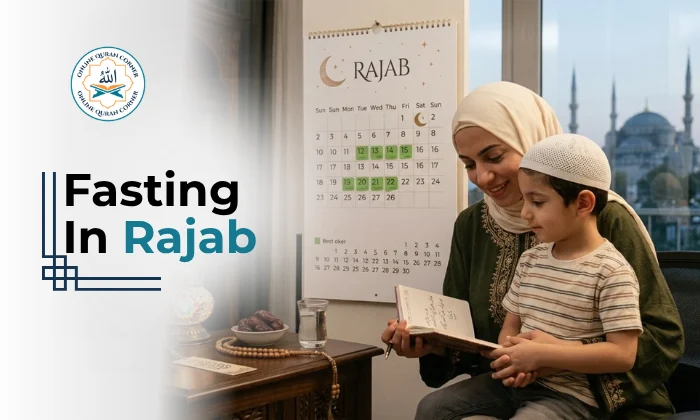
Parents and students preparing for the year ahead often ask one quiet question: How should I approach fasting in Rajab?
This guide covers what matters: the dates, the rulings, the best days to fast, and the intention every fast needs.
Nothing here assumes prior knowledge of Islamic jurisprudence. By the end, you will know exactly how to plan a Rajab fast.
You will also see why scholars encourage moderation, and how this sacred month fits into the journey toward Ramadan.
Rajab fasting is voluntary, meaningful, and manageable once the basics are clear. Let us start with what makes this month sacred in the first place.
We will also cover the intention every fast needs, the best days, and how women and qada fasts fit in.
Ready to Deepen Your Worship This Rajab?
A guided tutor can help you plan worship, recitation, and fasting with real structure. Online Quran Corner connects students with verified scholars for exactly this kind of support.
What Is Rajab and Why Is It a Sacred Month?
Rajab is the seventh month of the Islamic lunar calendar, sitting between Jumada al-Thani and Sha’ban. It holds a distinct status among the twelve months.
Classical scholars describe Rajab as one of four months Allah singled out as sacred, based on Surah At-Tawbah (9:36). Bloodshed was historically forbidden during these months.
Independent Islamic research institutions have studied why these four months carry this status. Yaqeen Institute’s research on the sacred months traces this history for readers wanting deeper context.
Scholars often describe the sacred months as a period where good deeds bring greater reward, and wrongdoing carries more weight. That framing helps explain why Rajab draws renewed attention every year, even without one obligatory ritual attached to it.
This sacred status is why many Muslims treat Rajab as a spiritual on-ramp. It is not obligatory worship, but a season many use to reset habits before Ramadan.
Understanding this context matters before discussing fasting in Rajab specifically. The month’s significance shapes why voluntary worship carries extra weight here.
Historians note that pre-Islamic Arab tribes recognised Rajab’s sanctity too, pausing conflicts before Islam confirmed the status.
Fasting in the Four Sacred Months
The four sacred months are Dhul Qadah, Dhul Hijjah, Muharram, and Rajab. Three fall consecutively, while Rajab stands alone.
Voluntary fasting during any of these months is recommended in general Islamic practice, not unique to Rajab specifically. Scholars link this to hadith encouraging extra good deeds during sacred time.
Rajab sits right before Sha’ban, which leads directly into Ramadan. That makes it a natural point to begin preparing spiritually.
Some students treat the stretch from Rajab through Sha’ban as one continuous runway. They gradually increase worship rather than making a sudden jump once Ramadan starts.
Families often use this window to review daily habits together, including how regularly a child completes their Quran recitation practice. Small, steady adjustments made now tend to hold up better once Ramadan’s busier schedule begins.
Rajab Fasting Dates and Calendar 2026
Because the Islamic calendar is lunar, Rajab shifts roughly eleven days earlier each Gregorian year. Its exact start depends on moon sighting.
This shift means Rajab gradually moves through every season over roughly thirty-three years, unlike fixed Gregorian holidays.
Rajab 1447 AH began on 21 December 2025 and concluded on 19 January 2026, per widely used Hijri references. The following Rajab, 1448 AH, is expected around December 2026.
| Detail | Approximate 2026 Information |
|---|---|
| Islamic year | 1447–1448 AH |
| Rajab 1447 AH starts | 21 December 2025 |
| Rajab 1447 AH ends | 19 January 2026 |
| Next Rajab (1448 AH) expected | December 2026 |
| Basis for dates | Moon sighting, subject to confirmation |
Always confirm local dates with a trusted moon-sighting authority or mosque before finalising a fasting schedule. Regional announcements can differ by a day.
Marking these dates on a family calendar, alongside Quran lesson times, helps avoid a last-minute scramble. Families working with Online Quran Corner often build this planning into regular lesson check-ins.
How Many Days Can You Fast in Rajab?
There is no fixed number of required days. Rajab has 29 or 30 days depending on the lunar cycle, and fasting any portion is valid.
Some students choose a handful of scattered days. Others follow the white days pattern discussed later in this guide. Either approach can be adjusted mid-month too, since starting late does not reduce the value of fasts that remain.
Both approaches are acceptable within mainstream scholarly opinion. What matters more than quantity is consistency and sincere intention. A short, honest intention held consistently across a handful of days often carries more benefit than an ambitious plan.
Students working through structured Quran classes often find it easier to slot fasting days around existing lesson routines. This beats treating worship as a separate, competing task.
Is Fasting in Rajab Sunnah, Recommended, or Bid’ah?
This is the single most searched question about the month. The honest answer requires nuance rather than a flat yes or no.
No authentic, specific hadith singles out fasting the entire month of Rajab as a distinct, named practice with special reward. This surprises many students learning about this topic for the first time.
However, Rajab falls within the general category of sacred months. Voluntary fasting is broadly encouraged there, the same way it is in other blessed periods.
Hadiths and Scholarly Views on Rajab Fasting
Scholars such as Ibn Rajab al-Hanbali noted that no strong hadith praises Rajab fasting above ordinary voluntary fasting elsewhere.
Weak or fabricated narrations promoting exaggerated Rajab-specific rewards have circulated widely. This is why many scholars caution against treating the month as uniquely superior.
This caution is not a rejection of fasting in Rajab altogether. It simply reframes it as general voluntary worship, not a separately legislated ritual.
The Moderate, Balanced Approach
Most contemporary scholars recommend treating Rajab fasting like any other nafl fast. It is welcomed and rewarded, but never obligatory.
This avoids two extremes: ignoring the sacred month entirely, or inventing rulings that were never established in authentic sources.
A balanced approach means fasting occasionally and sincerely, without assuming Rajab fasting outweighs fasting during other blessed times of year.
Tutors who hold a verified Ijazah are usually well placed to explain this nuance clearly. Their own training required exactly this level of scholarly grounding.
Ask to See the Verified Chain Behind Your Learning
Questions about fasting, worship, and Islamic rulings deserve answers grounded in real scholarship, not guesswork. Online Quran Corner’s tutors hold verified Ijazahs and can guide students through exactly this kind of question.
Which Days Are Best to Fast in Rajab?
While no day in Rajab carries a uniquely mandated fast, several days are commonly chosen based on broader Islamic practice.
Choosing recognisable days also makes it easier to plan around family schedules and existing Quran lesson times.
The white days are the 13th, 14th, and 15th of any Islamic month. This well-established sunnah is often applied during Rajab too.
Fasting on the 27th of Rajab (Isra and Mi’raj)
The 27th of Rajab is traditionally associated with Isra and Mi’raj, the Prophet’s night journey and ascension.
Many communities mark this date with extra worship. Scholars note there is no authentic hadith specifically commanding a fast on this exact day.
Some students still choose to fast on the 27th as personal, voluntary worship. They understand it as a preference, not a specific obligation.
Fasting on Mondays and Thursdays in Rajab
Fasting on Mondays and Thursdays is a general, well-documented sunnah practiced year-round. Rajab is no exception to this pattern.
This option suits students who want consistent, sustainable worship rather than one concentrated burst late in the month.
It also suits beginners easing into voluntary fasting, since two set days a week are easier to sustain.
Combining Monday and Thursday fasts with the white days gives a realistic, spread-out rhythm. Many tutors recommend this to beginners.
The Spiritual Benefits of Fasting in Rajab
Voluntary fasting builds self-discipline that carries directly into Ramadan. This makes the transition noticeably smoother for many students.
This kind of voluntary worship also creates space for reflection before the busier demands of Sha’ban and Ramadan arrive.
Many students say this quiet reflection is what they value most, more than the physical discipline of the fast itself.
| Benefit | Why It Matters |
|---|---|
| Builds fasting stamina | Eases the physical adjustment before Ramadan begins |
| Encourages early intention-setting | Strengthens mindfulness around worship goals |
| Creates consistent worship habits | Supports Quran recitation and prayer routines |
| Offers quiet reflection time | Reduces the rush many feel entering Ramadan unprepared |
None of these benefits require a full month of fasting. Even a few well-chosen days can shift a student’s readiness for Ramadan.
Students who track their energy during a Rajab fast often gain a clearer sense of pacing suhoor for Ramadan.
Pairing fasting with daily Quran recitation tends to deepen this effect further, since both practices reinforce patience together. Online Quran Corner’s lesson structure is built with exactly this kind of pairing in mind.
Journaling a short note after each fast can help students notice patterns worth carrying into Ramadan.
How to Make Intention (Niyyah) for a Rajab Fast
Niyyah, or intention, is a mental commitment made before dawn. It is not a formula that must be spoken aloud in Arabic. A student intending fasting in Rajab simply decides, before Fajr, that they are fasting that day for Allah’s sake.
Unlike Ramadan, voluntary fasts allow more flexibility. Some scholars permit forming the intention any time before midday, if nothing has been eaten since dawn.
This flexibility helps students who decide spontaneously to fast, rather than planning the day in advance.
Suhoor and Iftar Duas for Rajab Fasting
Suhoor, the pre-dawn meal, is recommended though not obligatory for voluntary fasts. It carries its own quiet blessing in Islamic teaching.
The standard dua before fasting expresses intention to fast the following day sincerely for Allah’s sake. Students may use their own words or the traditional Arabic phrasing.
At iftar, the traditional dua thanks Allah for enabling the fast. It expresses gratitude for the sustenance about to be taken.
Students unsure of exact wording can ask a tutor directly. Online Quran Corner’s instructors regularly walk students through these worship questions during lessons.
Can You Make Up Missed Ramadan Fasts During Rajab?
Yes. Making up missed Ramadan fasts, known as qada, is encouraged as soon as reasonably possible. Rajab is a perfectly valid month for it.
There is no specific requirement to complete qada fasts before Rajab. Many scholars simply recommend finishing them before the next Ramadan begins.
Delaying qada fasts for too long is generally discouraged. Obligations left unresolved for years can become harder to track accurately.
Rajab’s sacred status makes it a popular, motivating time for students delaying qada obligations from a previous year. Tutors at Online Quran Corner can help map out a realistic schedule for clearing these fasts.
A short conversation with a tutor often turns a vague goal into a concrete weekly plan.
Can You Combine a Qada Fast With a Rajab Fast?
Scholarly opinion is divided here. Some scholars allow a single fast to count as both qada and voluntary Rajab worship, through combined intention.
Others hold that qada, being an obligation, should be intended purely as qada. Voluntary Rajab fasting is then kept as a separate, additional fast.
The safer, more widely recommended approach is intending the fast specifically as qada first. Extra voluntary days can then be added separately for fasting in Rajab itself.
Discussing this with a knowledgeable tutor before Rajab begins removes guesswork, especially for students juggling several years of qada fasts.
Can Women Fast in Rajab?
Yes, women can and do fast in Rajab exactly like men, following the same voluntary guidelines described throughout this guide.
Women who are menstruating or experiencing postpartum bleeding are exempt from fasting during those days. This is consistent with rulings for any voluntary fast.
Missed voluntary fasts generally do not require replacement, unlike missed Ramadan fasts. Some women still choose to make them up out of personal preference.
Tracking which days were fasted, even in a simple notes app, makes future white days easier to plan.
There is no penalty either way, so this comes down entirely to personal preference rather than any binding religious rule.
Pregnant or nursing women should weigh health considerations carefully. Consult both a knowledgeable scholar and a physician before committing to voluntary fasting days.
Younger girls approaching puberty may also have questions about when fasting becomes expected of them. This is worth discussing gently and gradually.
Mothers introducing these ideas to children can lean on structured Islamic studies lessons for age-appropriate explanations.
Other Recommended Acts of Worship During Rajab
Fasting is only one of several practices scholars recommend during Rajab. Combining several builds a fuller, more balanced month of worship.
Treating these practices as a set, rather than picking just one, gives the whole month a steadier, more purposeful rhythm.
Our broader guide to essential Islamic practices covers many of these habits in more depth, beyond Rajab specifically.
1. Increase Dhikr:
Remembrance of Allah through short, repeated phrases is easy to maintain daily, even alongside fasting or a busy schedule.
2. Performance of Nafil Salâh -Supererogatory Prayer
Additional voluntary prayers beyond the five obligatory ones strengthen consistency and often pair naturally with fasting days.
3. Repentance and Seeking Forgiveness
Sincere repentance, or tawbah, is encouraged year-round but carries particular weight during sacred months like Rajab.
4. Giving Charity (Sadaqah)
Regular charity, even in small amounts, is a widely recommended practice during Rajab and the months leading into Ramadan.
5. Fasting (Voluntary)
As covered throughout this guide, voluntary fasting remains one of the most commonly practiced acts of worship during Rajab.
6. Recitation of the Quran
Consistent Quran recitation pairs naturally with fasting days. Many students use Rajab to rebuild a daily reading habit before Ramadan.
7. Prepare for Ramadan
Rajab is widely treated as preparation season: reviewing tajweed rules, setting realistic Hifz goals, and planning a workable Ramadan routine.
8. Observe abstinence from disobedience and sin:
Sacred months are traditionally associated with heightened self-restraint. This extends beyond food and drink into speech and daily conduct.
Frequently Asked Questions
Is Fasting in Rajab Mandatory?
No. This practice is entirely voluntary. It carries no obligation, unlike the fasts required during Ramadan each year.
Can You Fast Every Day in Rajab, or Just One Day?
Both are valid. Some students fast a single day; others fast several days weekly. There is no fixed requirement either way.
Is Rajab Fasting Different From Ramadan Fasting?
Yes. Ramadan fasting is obligatory for eligible adults. Rajab fasting is voluntary and allows more flexibility around timing.
Can You Eat and Drink Between Fasts in Rajab?
Yes. Voluntary Rajab fasts follow the same daily pattern as any fast, with eating and drinking permitted from iftar until dawn.
Is It Too Late to Start Fasting Partway Through Rajab?
No. Students can begin fasting in Rajab at any point in the month. There is no requirement to start on day one.
Final Thoughts
Fasting in Rajab is a voluntary, flexible practice rooted in the month’s sacred status, not one specific named hadith. Whether a student chooses the white days, Mondays and Thursdays, or the 27th, the goal stays the same: sincere worship.
Pairing fasting with dhikr, charity, and daily Quran recitation builds real momentum heading into Sha’ban and, eventually, Ramadan itself. For students wanting guided support, a qualified tutor can answer specific fiqh questions and help structure a realistic worship plan.
A short planning session before Rajab begins is often enough to set the whole month on a steady, sustainable track.
Rajab, ultimately, is a quiet invitation rather than a demand. Treat this kind of voluntary fasting as one small, sincere step among many.
Explore our full range of courses to see how recitation, tajweed, and Hifz lessons support this preparation year-round.
Start Preparing for Rajab and Ramadan With Online Quran Corner
Build Real Momentum Before Ramadan Arrives
Questions about fasting, worship, and Islamic rulings deserve answers grounded in real scholarship, not guesswork. Online Quran Corner’s tutors hold verified Ijazahs and can guide students through exactly this kind of question.