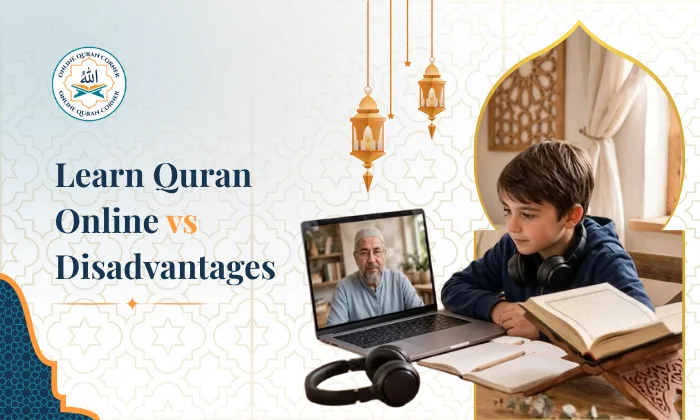
More UK families now search for ways to learn Quran online than ever, but few guides weigh the trade-offs honestly. This guide sets out the real pros and cons of learning Quran online: what a live lesson actually involves, where it beats a mosque or madrasa, where it falls short, what it costs, and how to vet a tutor safely before you commit.
We’ve built it around the questions UK parents and adult learners actually ask, not a generic sales pitch for one format over the other.
Online learning doesn’t suit every family or every child, and we’ll flag the genuine disadvantages of learning Quran online alongside the benefits, not just the case for it. At Online Quran Corner, we run live, one-to-one online Quran classes for children and adults across the UK, and this guide draws on the questions families raise most often when deciding between online and in-person options.
Ready to see whether online Quran classes fit your family?
Book a free trial lesson with Online Quran Corner.
This guide is written for UK parents weighing options for their children, adult beginners considering online Quran classes for themselves, and anyone comparing the cost, safety and effectiveness of learning Quran online against a local mosque or private in-person tutor.
What does online Quran learning actually involve?
Online Quran learning usually means a live, one-to-one video lesson on Zoom, Skype, or a dedicated platform between a student and a qualified tutor, following a set curriculum rather than a loose call. A typical session includes recitation practice with real-time pronunciation correction, Tajweed rules, memorisation targets, and short homework between lessons.
This is different from watching pre-recorded videos, which lack the live correction a tutor provides, or from generic screen-sharing apps not built for religious instruction. Most reputable providers, including Online Quran Corner’s own online Quran classes, run 30–60 minute sessions several times a week, with progress tracked lesson to lesson rather than left informally to the student.
The format varies by provider and by student age. Younger children typically start with letter recognition and basic pronunciation through a Qaida course, while adult beginners and returning students often move straight into recitation with correction.
Whatever the starting point, the defining feature of genuine online Quran learning as distinct from a casual video call is a qualified tutor actively listening and correcting in real time, not simply reading alongside the student. Most platforms also allow a parent to sit in on a child’s lesson unannounced, which is worth confirming directly with any provider before enrolling.
The Benefits of Learning Quran Online
Learning Quran online has grown quickly across the UK for reasons that go beyond convenience alone. The points below are the benefits parents and adult learners report most consistently, based on the questions we hear most often from new families.
Flexibility and Convenience
Lessons fit around school, work and prayer times rather than a fixed mosque slot with no commute. That’s a real win for families juggling several children’s schedules. Missed lessons get rescheduled rather than lost for the week, which matters across a school year full of clashes.
Personalised, One-to-One Teaching
Unlike a madrasa classroom of fifteen or twenty children, online lessons are almost always one-to-one. The tutor sets the pace to the student, not the group. It’s consistently the most-cited advantage in parent feedback especially for children who quietly fall behind in a group rather than ask for help.
Affordability Compared to In-person Tuition
Without premises, transport or group overheads, online tutors can often price lessons lower than a private in-person tutor, while still offering more individual attention than a crowded free mosque class. Exact costs are covered further down this guide, alongside a note on where the savings genuinely come from rather than a vague claim of being “cheaper”.
A Consistent, Structured Curriculum
Reputable online providers follow a defined path Qaida, then recitation, then Tajweed, then memorisation with progress tracked, rather than the more variable pace of a volunteer-led mosque class. This structure is a growing reason online Quran learning appeals to busy adult beginners too, since it removes the guesswork of what to study next.
Interactive Tools and Technology
Screen sharing, digital Mus’haf annotation, and recorded sessions for revision are tools a physical classroom rarely offers. For learners who benefit from repetition, replaying a tutor’s correction between lessons is a genuine teaching advantage, not just a convenience.
The Disadvantages of Learning Quran Online
None of this makes online learning free of real drawbacks. Any honest comparison has to weigh these against the benefits above, rather than presenting online Quran classes as a strictly better option in every case — and a good provider should be upfront about them too.
Technology and Connectivity Issues
A poor connection, an old device, or several people sharing one screen can genuinely disrupt a lesson something that never affects an in-person class. Families with unreliable broadband should treat this as a real risk. Test a provider’s platform during a free trial before paying.
Limited Face-to-face Interaction
Even a good webcam can’t fully replace being physically present for a tutor to correct posture and articulation subtleties during recitation. A genuine limitation, particularly for the physical side of prayer practice, not Quran reading alone. Some fine details of tongue and mouth positioning for certain Arabic letters are simply harder to see through a screen.
Distractions at Home
A child’s bedroom or living room comes with siblings, toys and notifications a mosque classroom simply doesn’t have. It’s one of the most frequently raised disadvantages of learning Quran online — usually solved with one quiet, consistent lesson spot.
Reduced Social Interaction
Mosque and madrasa classes give children a peer group learning alongside them and a sense of communal worship that a one-to-one video call, however well run, doesn’t replicate. For families who value that community dimension highly, this is a genuine trade-off, and it’s one reason many opt for a hybrid model rather than online lessons alone, covered further down this guide.
Requires More Self-discipline
Without the structure of physically showing up, both children and adults need more self-motivation to complete homework between sessions. Learners who struggle with self-directed routines may find this the toughest disadvantage of learning Quran online in the first few weeks.
Can online Quran classes replace in-person learning?
This is one of the most-searched questions on the topic, and the honest answer is: partially, and it depends on the learner, a well-run online lesson with a qualified tutor can match and, through one-to-one attention, sometimes exceed a crowded in-person class.
Multiple UK-based providers report comparable memorisation and recitation outcomes between online and in-person students when lesson frequency is similar.Where online classes genuinely can’t fully replace in-person learning is the communal side of worship, congregational prayer, wudu taught hands-on, and the peer environment of a mosque class.
Most educators recommend online Quran classes as either a complete solution for busy families, or a supplement to occasional in-person community attendance, rather than a strict either/or choice.
The honest framing most UK tutors use with new families is that online Quran learning replaces the academic delivery of a lesson very well, but doesn’t replace the wider role a mosque plays in a child’s or adult’s religious and social life. Families weighing this question are usually better served by asking “replace for what purpose” rather than treating it as a single yes-or-no decision.
Online vs In-person Quran Classes — a Direct Comparison
Both formats can produce a strong reciter or a confident young hafiz the difference lies in how they get there, and what else comes attached to the learning. The table below summarises the practical differences UK families ask about most when comparing online Quran classes against a local mosque or madrasa.
| Factor | Online Quran classes | In-person classes |
|---|---|---|
| Flexibility | High reschedule around your week | Fixed timetable |
| Class size | Usually one-to-one | Often 15–20+ students |
| Cost | Typically lower per hour | Free or low-cost at mosques; higher for private tutors |
| Commute | None | Required |
| Community aspect | Limited | Strong |
| Tech dependency | Needs stable internet/device | None |
| Progress tracking | Usually structured and logged | Varies by teacher or mosque |
Neither format wins outright,the right choice depends on what a specific family or student needs most. A family prioritising community ties and free access might lean toward a local mosque; a family prioritising consistency, individual pace and scheduling control tends to lean toward online Quran classes. Many end up somewhere between the two, which is exactly what the hybrid model below is designed for.
Which approach works better for UK families?
For families near a strong mosque with structured classes, in-person learning still works well especially for the community element. But for families juggling work, school runs and several children’s activities or without a nearby teacher they trust online Quran classes solve a real logistics problem.
Adult beginners tend to do especially well with online Quran learning: evening or weekend one-to-one sessions fit around work far more easily than a mosque’s fixed class times, and the privacy of learning to read from scratch without younger classmates present removes a common source of embarrassment for adults starting later in life.
Families with more than one child often find online Quran classes practical for a different reason again: siblings at different reading levels can each get lessons matched to their own pace, rather than one child being held back or pushed ahead to match a group of mixed ability at the mosque. This alone is often enough to tip the decision for larger families.
Choosing a Hybrid Approach
Many UK families increasingly split the difference: structured online lessons for recitation, Tajweed and memorisation during the week, alongside occasional mosque attendance for Friday prayer, Eid and community events.
This keeps the academic progress of one-to-one online teaching while preserving some of the community exposure that online lessons alone can’t fully provide. It’s a particularly practical model for families with children at different learning paces, since online lessons can be scheduled individually per child. Our Islamic Studies for Kids programme is designed to sit alongside, rather than replace, a child’s existing mosque involvement.
In practice, a hybrid week might look like two or three short online lessons focused on recitation and Tajweed, plus a Saturday morning at the mosque for group learning and prayer. Neither side has to carry the full weight of a child’s Islamic education alone, which tends to reduce the pressure on both the family’s schedule and the child’s attention span. Most families find this balance settles naturally within the first month or two, once both routines are in place.
What do online Quran classes cost?
Pricing varies by provider, tutor experience and lesson frequency, so treat the figures below as a general UK market guide rather than a fixed quote.
| Package | Typical UK range | Notes |
|---|---|---|
| Free trial lesson | £0 | Most reputable providers offer one |
| Pay-per-lesson | £8–£15 | Varies by tutor experience |
| Monthly (2–3 lessons/week) | £60–£120 | Most common family package |
| Family/sibling discounts | Often 10–20% off | Ask providers directly |
Three things move the price most: tutor experience, lesson frequency, and whether you book per-lesson or on a monthly plan. Providers priced well below this range deserve extra scrutiny on tutor vetting, because properly checked, qualified tutors have a cost floor that a truly budget provider can’t undercut.
A free trial lesson is worth treating as a genuine evaluation, not just a formality it’s the best opportunity to judge a tutor’s teaching style, patience with a nervous child, and technical setup before any money changes hands.
See What Your Free Trial Includes
Experience a live Quran class with Online Quran Corner and see if the learning approach is right for you.
Tutor Vetting and Safeguarding: How to Avoid the Risks
Online Quran learning puts a child on camera, one-to-one, with an adult they’ve likely never met. Safeguarding has to be a first-order concern not an afterthought. This matters more, not less, than an in-person class, since there’s no other adult in the room and no way to casually observe a lesson.
Checking Quran Teacher Qualifications
Ask any provider directly: what’s the tutor’s ijazah or certification, how many years have they taught, and can you see a sample lesson first? A reputable provider answers without hesitation. Online Quran Corner publishes tutor backgrounds on its instructors page rather than leaving parents to ask blind.
Background Checks When Tutors Teach From Overseas
In the UK, teachers working unsupervised with children are usually checked through the Disclosure and Barring Service (DBS). DBS checks are designed for UK-based roles, so most tutors teaching from overseas cannot hold one, and the better question is what a provider does instead.
Ask any provider exactly how they check a tutor’s identity, references and teaching certificates, and ask to see that confirmation rather than taking a website claim at face value. Parents should also expect lessons to be recordable or supervisable on request, with a clear point of contact for any concern.
Beyond the check itself, ask how a provider handles lesson recordings, who has access to them, and how long they’re kept a transparent answer here is usually a good proxy for how seriously a provider takes safeguarding more broadly, not just as a box-ticking requirement.
How to Choose a Quran Teacher or Course Online
With so many providers now offering online Quran classes, quality varies a lot. This short checklist helps you narrow it down quickly:
- Confirmed tutor qualifications, ideally including an ijazah (a formal chain of certification)
- A free trial lesson before any payment commitment, so you can judge fit before paying
- Clear identity, reference and certificate checks on every tutor, confirmed in writing rather than just claimed
- A structured curriculum, not just informal recitation practice with no clear next step
- Clear, published pricing rather than vague quotes given only after a sales call
- Female tutors available on request, where relevant to your family
- Genuine parent reviews from an independent source, not just testimonials on the provider’s own site
Our guide to choosing an online Quran teacher goes through each of these in more depth, including questions to ask on a first call and red flags that suggest a provider isn’t ready for your family yet.
Frequently Asked Questions
Are online Quran classes as effective as in-person lessons?
For core recitation, Tajweed, and memorisation, one-to-one attention often leads to faster correction than crowded classes because tutors can hear every mistake. The main limitation is the communal aspect of worship, which online lessons cannot fully replicate.
Is online Quran learning safe for young children?
It can be, provided the provider checks every tutor’s identity, references and qualifications, offers supervised or recordable lessons, and is transparent about tutor backgrounds. Parents should always ask directly rather than assume a provider meets these standards by default, see our safety guide for a fuller breakdown of what to check before enrolling a child.
Can my child have a female Quran teacher online?
Most reputable providers, including Online Quran Corner, can match female students or families who prefer it with a female tutor on request. Confirm this when enrolling, as tutor options vary by provider.
Should I switch my child from the mosque to online classes?
Not necessarily. Many families combine online lessons for structured progress with mosque attendance for community and congregational prayer. Fully switching online may suit families without a nearby mosque more than those seeking extra structure.
Do online classes work for adult beginners?
Often better than in-person options, as evening and weekend one-to-one sessions fit around work more easily than fixed mosque classes. Adults may also prefer the privacy of learning Quran online without younger students around.
If your question isn’t covered above, most reputable providers, including Online Quran Corner, are happy to answer it directly on a free introductory call before you commit to any lessons.
Final Thoughts: Is Learning Quran Online Right for you?
There’s no universal answer here, It depends on your household’s schedule, your child’s learning style, your access to a trusted local mosque, and how much weight you place on community worship versus one-to-one academic progress.
This guide has tried to set out the genuine benefits and the genuine disadvantages of learning Quran online honestly, rather than only the case for one format. If you take one thing from this guide: prioritise tutor vetting and safeguarding as highly as curriculum and price. A cheaper option that skips proper checks isn’t the better choice.
Whatever you decide, the goal is the same one every format shares: a child or adult learner who reads with confidence, understands what they’re reciting, and enjoys the process enough to keep going.
For most UK families juggling work, school and multiple children, a well-vetted online provider or a hybrid of online lessons and occasional mosque attendance tends to offer the best balance of flexibility, safety and progress.
Browse our full course catalogue or book a free trial lesson to find the right Quran program for you.